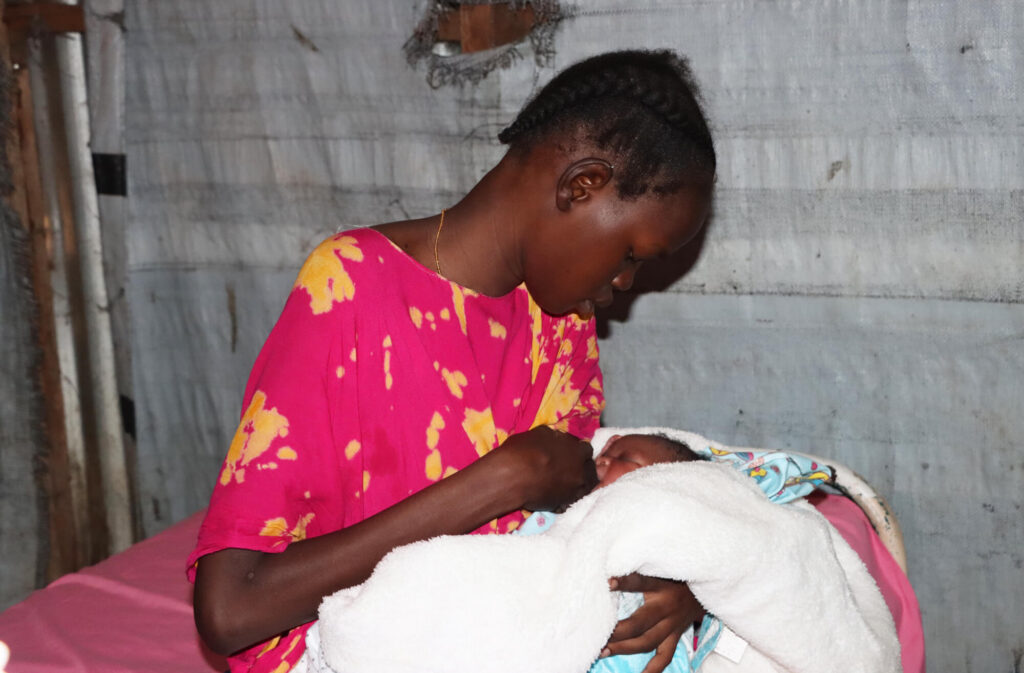
In many countries around the world, midwives are critical to ensuring safe deliveries for both mothers and babies. Yet the International Confederation of Midwives estimates that the world is facing a shortage of nearly 1 million skilled birth attendants. Chuol Ker Yat Pan is one of a growing cohort of midwives helping to fill the gap in South Sudan.
Chuol initially joined International Medical Corps in Walgak, South Sudan, as a volunteer, before being trained to become a nurse assistant. His supervisor saw that he had a strong interest in the medical field and asked him if he would like to attend the Kajo-Keji Health Science Institute, which International Medical Corps then supported to offer midwifery and nursing training in the face of a severe shortage of healthcare workers in South Sudan. Chuol chose to pursue a certificate in midwifery.
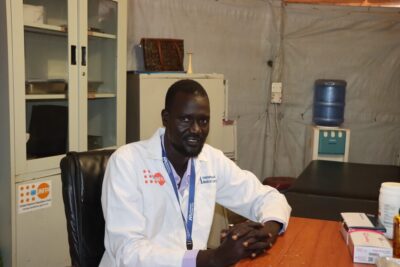
“I had seen the suffering of the community in Walgak, especially the suffering of mothers, and I believed that if I studied midwifery, I could change something, and I could support the community,” Chuol says. “When the opportunity came to study midwifery, I was very happy. Being a midwife means that two lives are saved in one go. That really amazed me and has encouraged me to continue working as a midwife.”
Since receiving his certificate in 2015, he has continued to add to his skillset, earning his midwifery diploma from the Juba School of Nursing and Midwifery three years later. At the end of this year, he will receive his Bachelor’s degree in midwifery from Ayii University.
“The most important thing is to ensure new knowledge and skills,” Chuol explains. “Confidence is built through study. The techniques that I’m continually learning change and improve my knowledge day by day—and that will enable me to provide more technical support on the ground.”
Since 2019, Chuol has worked in progressively senior roles at International Medical Corps, serving in Juba’s camps for internally displaced persons (IDPs). In his current role as Senior Midwife Supervisor, he oversees prenatal, delivery and postnatal services administered by the midwife team, and provides support when expectant mothers experience complications.
He recently led his team through a frightening delivery, when a mother developed eclampsia and started having seizures during labor. Though the woman needed to be referred to a larger hospital for specialised care, she couldn’t be transported until her condition was stabilised. For two hours, Chuol directed the team in administering magnesium sulfate, an anti-convulsive drug to stop the seizures, and hydralazine, an anti-hypertensive medication to lower her blood pressure—all while monitoring her vital signs to make sure her blood pressure didn’t drop too low, which would cause other complications. The team succeeded in stabilising the woman, and she was transferred to the Juba Teaching Hospital, where she safely delivered a healthy baby boy. When the woman returned home to the IDP camp, Chuol and his team were there to provide postnatal care to her and her infant.
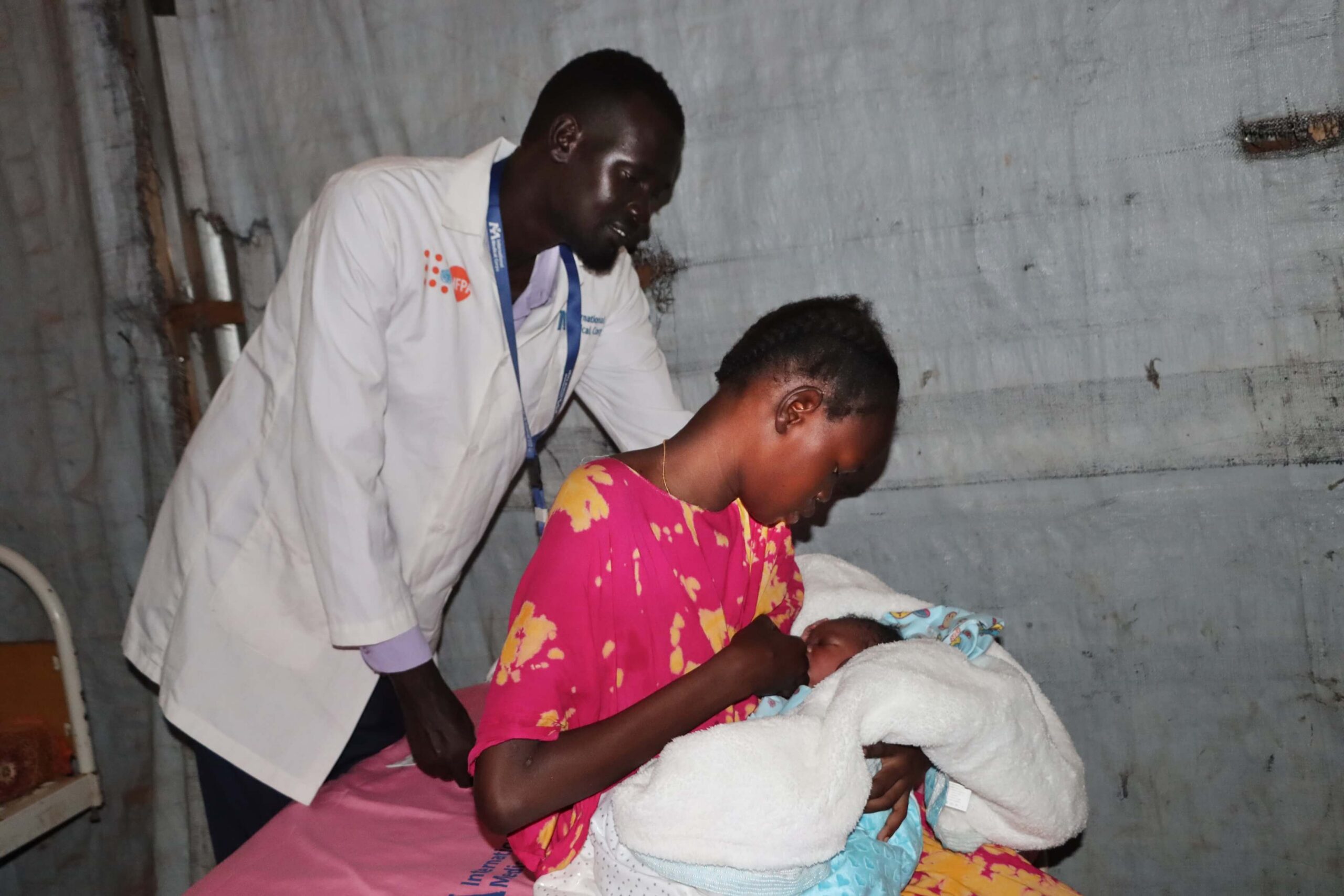
He emphasises the importance of understanding patients and their needs so that treatment can take place as soon as possible.
“When you’re working in a health facility where you don’t have access to all possible interventions, the key is to ensure early identification of pregnancy complications, because if you identify these early, it will give you the upper hand to handle the case successfully, since you will know what level of support the case needs,” Chuol explains.
Chuol’s hard work has not gone unnoticed: he was proud to receive a certificate of appreciation from his colleagues in 2024. But what makes him even prouder is that, since he joined International Medical Corps in 2019, there have been no maternal deaths in Juba’s IDP camps.
“I believe that I’m contributing to the reduction of maternal mortality in South Sudan,” he says.
“Mothers Give Me Hope”
In South Sudan, a country with one of the highest maternal mortality rates in the world, training more midwives is incredibly important. Though the country has made great strides in growing its roster of trained midwives—going from only 12 fully qualified midwives in the entire country in 2011 to more than 3,000 today—there are still far too few skilled birth attendants for a country of 12 million people. “The most important thing is to ensure that people continue to study midwifery, so that more mothers are saved around the globe and so that the lives of newborn children are improved,” Chuol says. “Midwifery is where humankind begins!”
Chuol believes the work that his team is doing is the best advertisement for midwifery training, “because when you do a good job and people see how you are treating your clients and how thankful your clients are, then people admire the job.”
Globally, fewer than 1% of midwives are men, though male midwives likely make up a much higher proportion in South Sudan—2020 research indicated that a recent cohort of more than 300 midwifery students was 36% male.
Chuol says that for men, becoming a midwife is an opportunity to better understand the difficulties women face from pregnancy to birth. “Being a midwife has given me a different understanding of the changes that happen to women during pregnancy, the pain women experience during delivery, the difficulty of caring for children,” Chol says. “What matters most is the equality of everyone, whether they are a woman or a man, and having respect for all. I believe men and women can equally be midwives. A man or a woman can provide support in any field of his or her interest.”
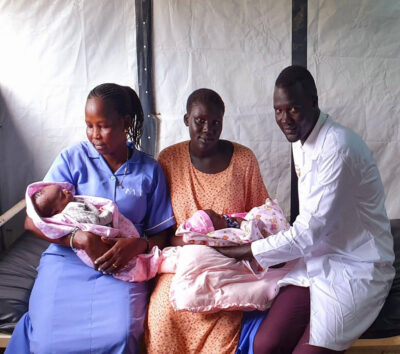
Chuol firmly believes that every mother and baby deserve a caring midwife who will attentively treat them with compassion and support.
“It’s mothers who give me hope,” Chuol says. “The confidence they have in me encourages me to continue.”