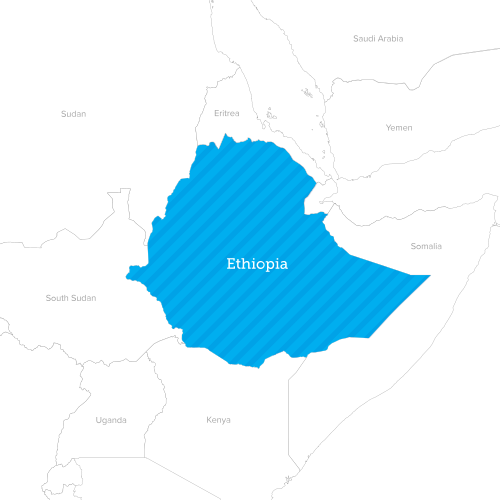
Ethiopia
Drought is one of two plagues that challenge Africa’s oldest independent country, leaving millions in need of food assistance for their survival. Ethiopia’s second challenge stems from a large population of displaced people due to conflict, political instability, extreme weather and outbreaks of infectious diseases. These overlapping crises have led to food insecurity, deteriorating health and increased vulnerability to malnutrition and mental health challenges.
International Medical Corps has worked in Ethiopia since 2003, providing lifesaving support to address these crises, including primary healthcare, maternal and newborn health (MNH), HIV/AIDS, mental health and psychosocial support (MHPSS), nutrition, food security, livelihoods and disaster-risk reduction, safe drinking water and hygiene assistance and services related to violence against women and girls (VAWG).
135.5 million
61/71 years
male/female
1.9 million
The Challenges
Refugees
Ethiopia hosts about 1.1 million refugees—the third-largest refugee population in Africa

Hunger
6.8 million require immediate food assistance

Drought
Due to erratic rainfall, Ethiopia is extremely susceptible to the effects of extreme weather, including drought and flooding
Our Response
We have provided humanitarian aid to Ethiopian communities, IDPs and refugees in more than 60 woredas (districts) across nine regions: Afar, Amhara, Benishagul-Gumuz, Gambella, Oromia, Sidama, Somali, Southern Nations Nationalities and Peoples’ Region (SNNPR) and Tigray. In 2025, we provided lifesaving services to nearly 3.2 million people.

Healthcare
Since 2015, International Medical Corps has supported local public health authorities to address health emergencies caused by disease outbreaks, drought, conflict and other crises. We have strengthened the government’s capacity to prepare for, investigate, and respond to emergency health needs during crises. We deploy mobile health, nutrition and surge teams to provide essential primary healthcare services; support routine and catch-up immunisation campaigns; strengthen health systems including referrals; procure and distribute medicines, medical equipment and medical supplies; and provide logistical assistance for last-mile delivery.
We have extensive experience in responding to outbreaks of cholera, malaria and measles—and we were a key partner responding to the Marburg virus disease (MVD) outbreak in Ethiopia, where we strengthened local and national capacity on case management, infection prevention and control, surveillance and risk communication and community engagement.
In 2025, International Medical Corps reached more than 1.4 million people in Ethiopia with health interventions. We also responded to disease outbreaks—including cholera, malaria and MVD—across Ethiopia, demonstrating our commitment to addressing urgent public health needs. Our targeted outbreak response efforts reflect International Medical Corps’ proactive approach to controlling outbreaks of infectious disease and strengthening health systems despite ongoing crises. Our emergency health teams provided lifesaving primary healthcare services, including maternal and child health and mental health services, by deploying mobile teams in hard-to-reach and conflict-affected areas.
To build local healthcare capacity and strengthen coordination, we provide training in public health emergency management, integrated disease surveillance and response, and related topics. We also conduct multi-sectoral rapid assessments, helping to design evidence-based health programmes while maintaining the capacity to deploy mobile health and nutrition teams (MHNTs) to remote areas.

Maternal and Newborn Health and HIV
Ethiopia has an estimated 195 maternal deaths for every 100,000 live births, which is significantly higher than the global average. Since 2013, International Medical Corps has implemented emergency and development programming related to MNH and HIV, strengthened local capacity and provided lifesaving healthcare in areas across the country. We provide adolescents with programmes that include peer-to-peer education covering such topics as adolescent and maternal nutrition, prevention of HIV and other sexually transmitted infections, early marriage, cervical cancer screening and management, female genital mutilation and life-skills training. We integrate lifesaving MNH services into emergency health response through the provision of antenatal and postnatal care, counselling and treatment of sexually transmitted infections, and care for survivors of violence against women and girls through MHNTs and surge teams, including midwives and obstetrician/gynaecologists supporting basic and comprehensive emergency obstetric and neonatal care. In 2025, International Medical Corps also provided maternal health services, including antenatal care for 28,491 pregnant women and skilled delivery for 21,962 women.

Mental Health and Psychosocial Support
International Medical Corps is one of the few emergency response organisations addressing immediate and long-lasting MHPSS needs in Ethiopia. Since 2014, we have implemented MHPSS programming for refugees, internally displaced persons (IDPs) and host communities with pre-existing and emerging mental health conditions in multiple areas across the country. We provide comprehensive services to reduce suffering and improve well-being. Our approach to MHPSS facilitates accessible, non-stigmatising, culturally acceptable and high-quality mental health services. Our psychosocial activities promote the capacity of the affected population by teaching life skills, offering recreational outlets and building social support networks. We strengthen the national health system by integrating MHPSS services and by training general healthcare staff and specialised providers. We strengthen coordination forums and co-chair the national and Tigray MHPSS technical working groups.
In 2025, International Medical Corps reached 121,779 people with services including clinical care for mental, neurological and substance use conditions, individual and group counselling, psychological first aid (PFA) and case management. We also trained 10,741 health workers and community leaders to facilitate psychosocial, social, educational, or recreational activities.

Nutrition
International Medical Corps supports the Ethiopian Ministry of Health’s nutrition programs in conflict- and drought-affected parts of the country to address food insecurity and malnutrition. We help refugees and host communities provide community-based management of acute malnutrition through health systems and mobile health and nutrition clinics. We provide a combination of nutrition screening, growth monitoring, nutrition counselling and micronutrient supplements, and management of acute malnutrition, working through available health facilities and community nutrition centres, and provide routine mother and infant consultations and other outpatient visits. We also promote nutrition education, proper child feeding, and healthy pregnancies by promoting key infant and young-child feeding practices. We provide technical support to partners and members of the Strategic Advisory Group, Nutrition Technical Working Group and Emergency Nutrition Coordination Unit.
In 2025, we screened 650,307 children under 5 and 218,305 pregnant and lactating women (PLW). Of these patients, our teams treated 74,370 children under 5 for moderate acute malnutrition and 11,400 children under 5 for severe acute malnutrition without medical complications. We also treated 46,808 PLW who were suffering from moderate acute malnutrition. Additionally, International Medical Corps provided 161,573 caregivers of children under 2 with vital information about infant and young-child feeding practices, including nutrition awareness sessions for mothers on different topics such as the importance of breastfeeding, dietary diversification using local foods and targeted nutritional support.

Food Security and Livelihoods
We provide integrated nutrition and food security services to reduce mortality and morbidity associated with severe acute malnutrition across four drought-affected regions. To address the impact of conflict and drought, we support a range of activities that promote and protect local agriculture and livestock, and to help build the resilience of families. Our activities include multi-purpose cash transfers; blanket supplementary feeding; general food distribution and meals at schools; entrepreneurship programmes; vegetable, fruit and poultry production; and fresh-food vouchers. We also provide crop seeds and farming tools, and livestock vaccine supplies and equipment. In 2025, International Medical Corps provided food assistance to 193,771 people.
International Medical Corps also trains community volunteers—mostly women—on nutrition education, screening and follow-up for malnourished children, and on essential nutrition actions, including exclusive breastfeeding, appropriate complementary feeding and other relevant preventive measures. We train members of mother care groups (MCGs) to actively promote nutrition and healthy behaviour by visiting households and conducting education sessions.
Through our livelihood interventions, we have provided an integrated approach to improve the nutrition status of children through the Positive Deviance Hearth Approach. We have supported 560 households with livelihood activities, including income-generating activities, vegetable gardening and livestock. We have provided livestock support for underserved families with 1,000 goats in Oromia, 600 chickens in Wolayita and 1,200 chickens in Tigray.

Water, Sanitation and Hygiene
International Medical Corps improves access to water, sanitation and hygiene (WASH) services both in conflict- and drought-affected communities by developing water sources; rehabilitating and upgrading existing water systems with environmentally friendly and reliable solar-powered energy sources, including at health facilities; constructing and rehabilitating emergency sanitation facilities; providing lifesaving WASH supplies, water trucking and environmental health services; and promoting safe hygiene and capacity building through training and by providing equipment and tools.
We implement comprehensive emergency WASH programmes to meet the emergency response, recovery and developmental needs of local communities, IDPs and returnees. In the North Gondar and Tigray areas, we have supported response activities that reduce the risk of a cholera epidemic. We provided emergency response services to communities affected by drought in Oromia region. We also delivered comprehensive WASH services for communities affected by MVD in South Ethiopia region.
In 2025, International Medical Corps reached 904,629 people across Ethiopia with comprehensive WASH services. Our sanitation efforts included the construction or rehabilitation of 97 latrines. To ensure sustainable access to clean water, International Medical Corps constructed or rehabilitated 139 water points. We also distributed more than 37.5 million litres of clean, safe water. We continued to expand our reach and impact by deploying dedicated standby teams to remote and hard-to-reach areas, delivering integrated WASH, nutrition and health services to communities in urgent need.
International Medical Corps also advanced its commitment to renewable energy by upgrading water systems with solar power capacities of up to 135 kW, enabling the operation of 75 kW surface pumps at Kebri Beyah and other project sites. These innovations not only reduce operational costs but also ensure a reliable and environmentally sustainable supply of safe water for thousands of people.

Violence Against Women and Girls
We implement programmes related to the response, prevention and risk mitigation of VAWG in areas across the country. Our VAWG services include psychosocial support and case management. We rehabilitate women’s and girls’ safe spaces to provide quality services to women and girls. We also train service providers on basic case management skills to support quality service provision. We train community network groups, volunteers and influential elders on basic concepts of VAWG, referral pathways, and prevention of sexual exploitation and abuse. To support community awareness on prevention, response and risk mitigation, we disseminate critical lifesaving information on available services, the importance of timely reporting, hold “coffee and tea” discussions, conduct adolescent-girl-focused sessions and home visits. To mitigate the risks of VAWG, we conduct safety audits and distribute dignity kits for women and girls. In 2025, we reached 481,815 people through prevention and response activities.
Our Impact in 2025
Crisis in Northern Ethiopia
Before a negotiated truce took hold in November 2022, the conflict in northern Ethiopia created millions of IDPs and refugees and caused widespread destruction. Although the region has since entered a recovery phase and despite ongoing rehabilitation efforts, many facilities in Tigray region continue to face operational constraints due to damaged infrastructure, shortages of medical equipment, essential medicines and health workforce limitations.
The nearby region of Amhara is also facing a complex situation characterised by ongoing conflict and humanitarian needs. Despite the truce, emergency response efforts face numerous challenges, including fuel shortages, electricity disruption and access problems due to insecurity.
Additionally, there are reports of displacement, with people seeking to return to their homes despite the risk of violence, particularly for women and girls. Amid these conditions, International Medical Corps provided an array of lifesaving health and related services to those affected by the conflict and its aftermath. These included vital nutrition, health, VAWG, MHPSS and WASH services in 26 sites hosting about 800,000 IDPs in the Afar, Amhara and Tigray regions. We also provided a range of services through mobile medical units (MMUs) in the regions.
Since 2022, International Medical Corps has provided services at 42 IDP sites and resumed all other operations in Tigray. Our team has shipped medicines and medical supplies, programme materials, and assorted sanitation and hygiene-related non-food items (NFIs) by road and air from Addis Ababa into Amhara and Tigray, resupplying our mobile teams and helping to address urgent programme needs.
We delivered comprehensive WASH support, including safe water supply by rehabilitating non-functional water systems, and through water trucking, improving sanitation access at IDP sites and health facilities, and establishing solid waste management systems at IDP sites and health facilities.
Nutrition Support Brings Hope to Displaced Families
At Bokolmayo Refugee Camp in Ethiopia, our dedicated teams provide lifesaving nutrition services and education to displaced families.
READ MORE


A boy holds a jerry can of water that he will take back to his family in the makeshift shelter where they were living after an earthquake destroyed their home.
Shukri Mohammed holds her daughter, Fatuma Abdi Ahmed, while they wait to see clinicians at International Medical Corps’ health facility in Bokolmayo Refugee Camp.
A woman holds chickens she received from International Medical Corps as part of our poultry and gardening program.
Aida, 8 years old, receives an asthma inhaler from an International Medical Corps health worker.
Children sit with their mothers during a nutrition education session at Bokolmayo Refugee Camp.
A woman sits with her child in a temporary shelter where they were living after an earthquake destroyed their home.