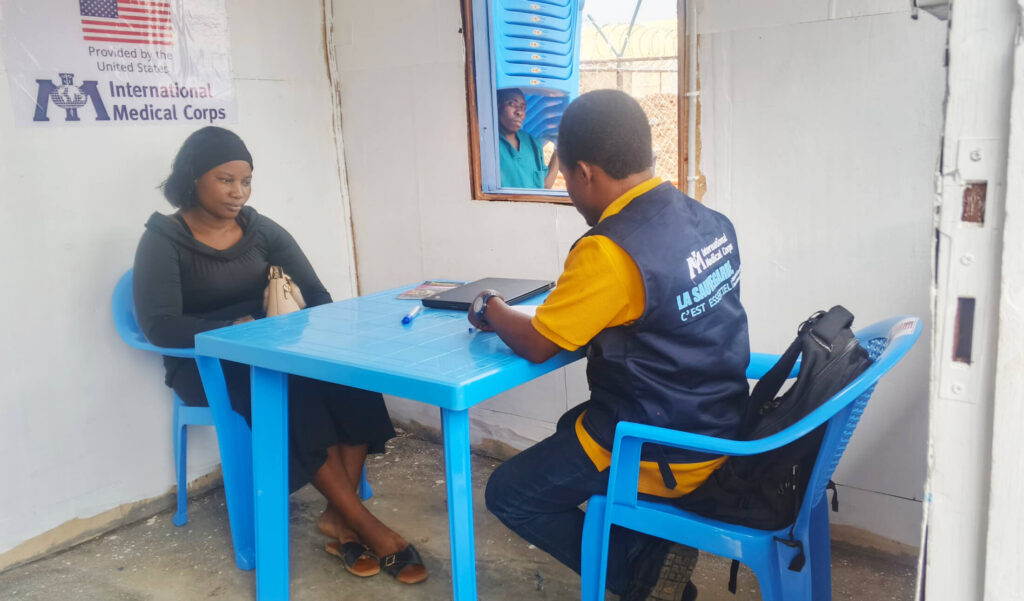
During an outbreak of disease, mental health and psychosocial support (MHPSS) services are paramount for everyone affected: patients, their family, members of the community and healthcare staff.
This is true as the Ebola outbreak rages on in the Democratic Republic of the Congo (DRC), where our MHPSS officers, psychologists and psychosocial support staff are hard at work. The team is providing psychosocial support to affected people and their families through the use of psychological first aid, emotional and grief support, and practical problem-solving support. They also are providing people with more severe mental health needs with referrals to advanced care.
Our MHPSS team in the DRC is serving as a link between health facilities and the community, acting as a go-between and providing information to families about patients who have been admitted to our Ebola Treatment Center (ETC). They provide reassurance to patients’ families by providing them with information they receive from the health workers who are in charge of their loved ones’ care.
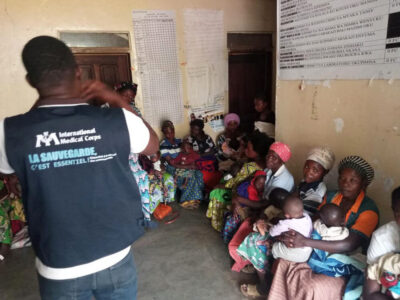
“One of the main challenges that we are facing for patients who have been admitted is that their families want to reach out to them, but in the current context, we cannot allow them to see or touch infected patients,” says Franck Noumbo, Global MHPSS Technical Unit Advisor. “They feel frustrated, and it adds a burden to what they are already facing. It’s our role as members of the MHPSS team to provide support, so that we lower their anxiety and frustration.”
The MHPSS team is also assisting in the important job of debunking the misinformation and reducing the stigma that surrounds Ebola. Rumours surround the ETCs, making sick people reluctant to seek treatment. And Ebola survivors often face fear and rejection from neighbours and community members after recovering from the frightening and misunderstood disease.
“We work closely with our risk-communication and community-engagement teams to address misinformation with empathy, rather than judgment,” Franck says. “This means that we listen to people’s fears, try to understand where the rumours come from and then provide clear information.”


Because healthcare workers are also in danger during this outbreak—112 healthcare workers have so far been infected and 35 have died of the disease during this outbreak—we also provide MHPSS services to them. Our team teaches healthcare workers how to maintain a sense of mental well-being, even during a difficult and dangerous outbreak response. We also partner with organisations that provide resources for people working in high-stress environments to help them maintain a healthy routine, exercise self-care and stay connected with family and friends. And our team provides referrals for higher levels of care if health workers have greater MHPSS needs than we are able to directly provide.
“Healthcare workers are exposed not only to the virus but to a huge level of stress. They need space to process their fear, exhaustion and grief, and they also need to learn practical strategies to maintain their own well-being while continuing their work,” Franck says.
Even though the focus is on preventing Ebola deaths and helping people recover, MHPSS is an important part of that battle.
“MHPSS is crucial because we are addressing the fear, the stigma, the stress, the anxiety that people are feeling,” Franck emphasises. “Our work is to make sure that people stay very calm despite the situation.”