Livelihoods
Nutrition & Food Security
A livelihood constitutes the ability to make a living. A livelihood is sustainable when it can survive the stress and shocks of the surrounding environment while not undermining the natural resource base.
For more than two decades, International Medical Corps has provided livelihoods assistance to enable communities to recover from disaster. In the face of armed conflict or natural disaster, those most vulnerable are often forced to sell off their limited wealth—including livestock, seeds and household goods—to purchase necessities required for survival, such as food, medicine and clothing, or to pay for school fees and other essential services.
Because of this, protecting and promoting livelihoods is central to our mission to support swift recoveries from disaster and to strengthen local capacities to survive future shocks. We help expand temporary income-earning opportunities—focusing, for example, on rebuilding, strengthening and diversifying the centers of wealth that communities draw upon for their livelihoods.
We support entrepreneurship and other market-based livelihoods, such as vocational and life-skills training. We provide cash grants, cash for work and non-farm income-generating activities. We support village savings-and-loan schemes to create job opportunities within communities—including for younger members of the community, who might otherwise be forced to migrate to earn enough to survive following a disaster.
Our Response
CAMEROON: Village Savings-and-Loan Support for Livelihoods
In Cameroon, we support conflict-affected and displaced communities by restoring and strengthening livelihoods through agriculture, livestock production and small-scale entrepreneurship. While national figures indicate that more than 3 million people face acute food insecurity, our programmes focus on helping families rebuild their income sources and reduce dependence on aid. Through vocational training, village savings-and-loan associations (VSLAs) and agricultural support initiatives, we are enhancing resilience and self-reliance among households across the Adamawa, East, Far North, North, Northwest and Southwest regions of Cameroon.
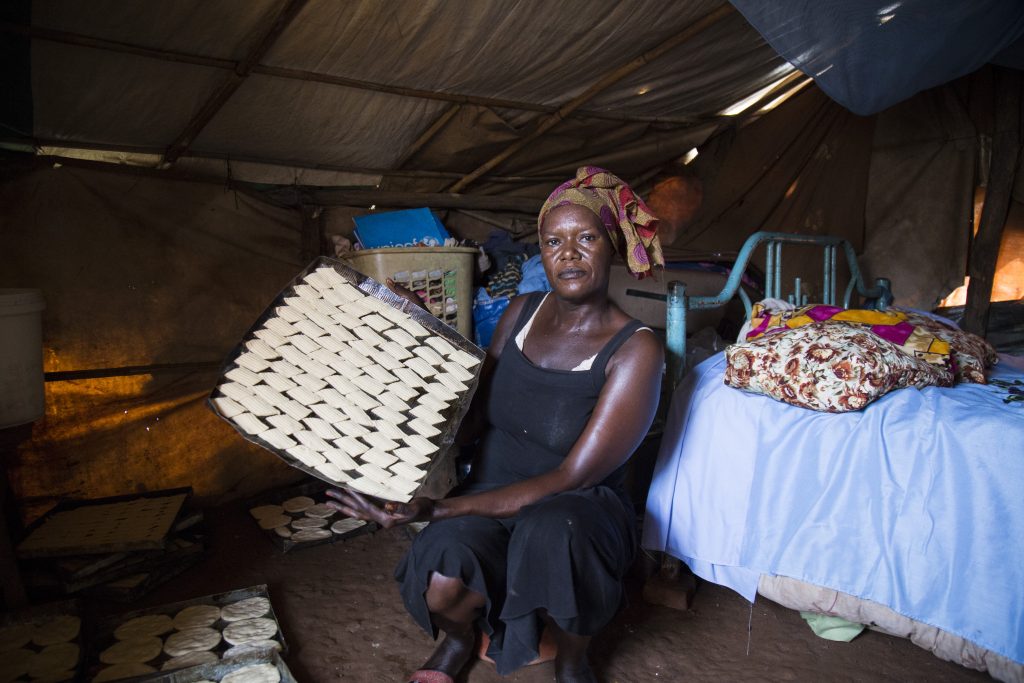
NIGERIA: Livelihood Support for Women
In northeastern Nigeria, we help displaced communities rebuild their livelihoods through agriculture, small-business development and VSLAs. Our Resilience and Social Cohesion project in Borno state reaches thousands of households with integrated livelihoods and nutrition support, including e-vouchers, income-generating activities and vocational training. Across the region, similar initiatives—implemented in coordination with partners—have supported thousands of families. For instance, in 2022, more than 3,300 people benefited from cash-for-work programmes, vocational training and small business start-up assistance. These efforts help strengthen self-reliance, restore income sources and reduce dependence on humanitarian aid.
YEMEN: Livestock Replenishment
Livestock is important to both livelihoods and food security, particularly in the developing world. It is a cultural symbol of wealth in some societies, as well as an asset that can be liquidated to meet food and other needs in difficult times. As food, livestock is a source of protein and minerals. In Yemen, we have distributed 3,600 sheep and goats to more than 1,200 households whose farm animals were lost to war and whose children struggle with severe or moderate acute malnutrition. The new animals have helped these households rebuild their livelihoods and have improved their access to nutritious animal-source food. We also have undertaken large-scale veterinary vaccination, deworming and treatment campaigns, in partnership with the Yemen Veterinary Service, to protect the livestock from depletion and to inform herders about improved animal production techniques. In addition, we have provided households with livestock feed.
ETHIOPIA: Promoting Market-driven Economic Opportunities
In Ethiopia, we support drought- and conflict-affected communities by restoring livelihoods and by strengthening household resilience. In 2024, we assisted about 560 households through income-generating activities, vegetable gardening and livestock rearing—including the distribution of 1,000 goats in Oromia, 600 chickens in Wolayita and 1,200 chickens in Tigray. Additionally, we have provided emergency livelihood support—including seeds and farming implements—that benefited more than 33,000 households, reaching nearly 200,000 people. And in 2025, we supported nearly 25,000 households with food assistance. These efforts help vulnerable families rebuild their assets, enhance food security and reduce dependence on humanitarian aid.
As many as half of young children globally suffer from micronutrient deficiencies—a condition better known as “hidden hunger.” International Medical Corps provided micronutrient supplementation to more than half a million children under 5 in 2024.
By 2050, the world will need to increase agricultural production by at least 60% to feed a projected 9 billion people in the world.
In 2025, we supported nearly 600,000 people with Food Security and Livelihoods (FSL) programming.