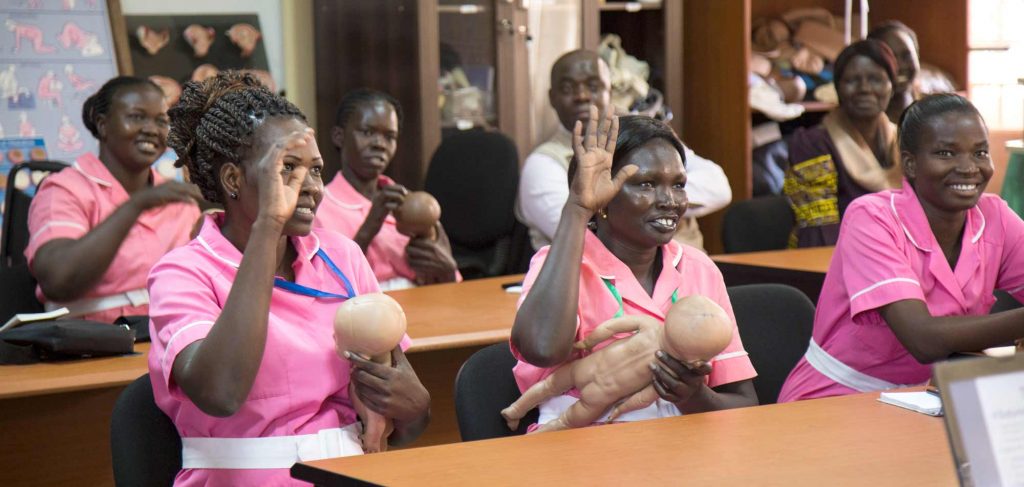
Training Activities
Building a Better Response
Strengthening capacity
An International Medical Corps-led consortium that includes Concern Worldwide and the Harvard Humanitarian Initiative. The BBR project’s goal is to enhance the knowledge and skills of national and international NGO workers while simultaneously connecting them more closely to the global system that organises a robust humanitarian response in times of emergency. Teaching tools include e-learning in three languages as well as more traditional classroom environments.
Trauma Care Training
A video series in Ukrainian and English
We have partnered with the Harvard Humanitarian Initiative to provide training to Ukrainian healthcare providers and others in emergency and trauma care and mass-casualty management, including chemical, biological, radiological, nuclear and explosive (CBRNE) hazards.
Programme on Humanitarian Leadership
Helping humanitarian professionals become better leaders
Training the next generation of humanitarian leaders by combining a rigorous academic curriculum with hands-on learning including mentorship, field assignments and field placements.
Humanitarian Response Training Unit Initiative
Strengthening the humanitarian community’s ability to respond when needed
The Humanitarian Response Training Unit (HRTU) specialises in projects that strengthen the capacity of the humanitarian community, enabling it to provide a more effective and coordinated response to the needs of affected populations. The HRTU implements training projects targeting multiple audiences, including government representatives and international and national NGOs, in the many aspects of humanitarian response and coordination. The HRTU also proactively positions International Medical Corps externally within this area of training and capacity strengthening.
National NGO Capacity Strengthening Project
Training for local national non-governmental staff
Strengthening the capacity of national non-governmental organisations to respond to humanitarian crises in their countries and regions, through needs assessment, training workshops and the development of work plans for targeted interventions by appropriate subject-matter experts.
Nutrition and Food Security
Training for local national non-governmental staff
Strengthening the capacity of national non-governmental organizations to respond to humanitarian crises in their countries and regions, through needs assessment, training workshops and the development of work plans for targeted interventions by appropriate subject-matter experts.
Nutrition and Food Security
E-TRAIN
Emergency Training for Response and Improved Nutrition (E-TRAIN). Implemented in 2016 with the Center for Humanitarian Emergencies at the Emory Rollins School of Public Health in Atlanta, E-TRAIN seeks to improve the public health response, management and operations in humanitarian emergencies by focusing on the emergency nutrition response.
Mental Health and Psychosocial Support
Mental Health in Complex Emergencies
An intensive multidisciplinary six-day training course for mental health professionals and programme staff who wish to establish mental health or psychosocial programmes in conflict and post-conflict areas. The course covers how to conduct rapid assessments, design and set up mental health services or psychosocial programmes, as well as undertake clinical work and therapeutic approaches in non-western contexts. International Medical Corps has co-organised this course for years jointly with Fordham University, UNCHR and HealthNet TPO.
Mental Health
Parent Skills Training
International Medical Corps participates in a WHO initiative, the Parent Skills Training (PST) Pilot Program, to provide evidence-based parenting skills training for caregivers of children with developmental delays and disorders. It is a global programme that can be implemented locally. The main goals of the programme are to promote better understanding and acceptance of developmental delay and developmental disorders, and help parents apply skills that promote child development, communication and functioning. The PST programme includes a training-of-trainers course for first responders and professionals in Syria, Jordan and Lebanon.
Violence Against Women and Girls
Traditions and Opportunities Toolkit
Programmes relating to violence against women and girls (VAWG) have long recognised the importance of engaging community leaders as gatekeepers, service providers and agents of change. Yet VAWG programmes have often lack tailored guidance and support to explore potential areas of community leader engagement and to navigate challenges related to this work, including risks of inadvertently reinforcing leadership structures that do not centre women and girls. With support from the United States government, International Medical Corps developed this toolkit to provide VAWG practitioners with new ideas, guidance, tools and resources to meet these challenges, and to safely and effectively engage community leaders to advance VAWG prevention and response in humanitarian settings.
The Traditions and Opportunities Toolkit is designed to serve as a resource in the work of VAWG programmes implemented by local, national and international organisations to address the issue in humanitarian settings—including conflict, natural disaster, displacement and different stages of emergency response. The toolkit does not outline a specific programme to follow, but instead includes guidance and tools that VAWG programme teams can adapt and apply to engage community leaders through existing or planned VAWG prevention and response programs, as appropriate to programme goals, context, resources and team capacity.
Violence Against Women and Girls
Learning programme
The United Nations Population Fund, International Medical Corps and Human Rights Education Associates have created a multi-phase global learning programme to increase the number of specialists with the technical knowledge and skills needed to respond to violence against women and girls (VAWG) in emergencies, including natural disaster, conflicts and population displacement, and to lead the design and implementation of VAWG prevention and response interventions.
Mentorship and Other Support
Initiatives and collaborations
Global Mentorship Initiative
International Medical Corps worked with UNFPA to pilot a VAWG mentorship initiative that was rolled out during the second year of the programme in 2017. Alumni of the first in-person training in 2016 were matched with mentors who were selected through a competitive call for mentors. Alumni were able to speak with mentors about programming challenges, share concerns, ask for career advice and other guidance. International Medical Corps and UNFPA held regular check-in calls with mentors to facilitate the exchange of best practices and lessons learned.
Support for the launch of a VAWG Area of Responsibility Community of Practice
International Medical Corps continues to partner with UNFPA on the development and implementation of the VAWG Area of Responsibility Community of Practice. The initiative’s goal is to strengthen professional support, provide continued learning opportunities and resources and encourage information-sharing between VAWG specialists.