FEATURED STORY

Being a Repeat Ebola Responder: “I Have to Give the Best of Myself”

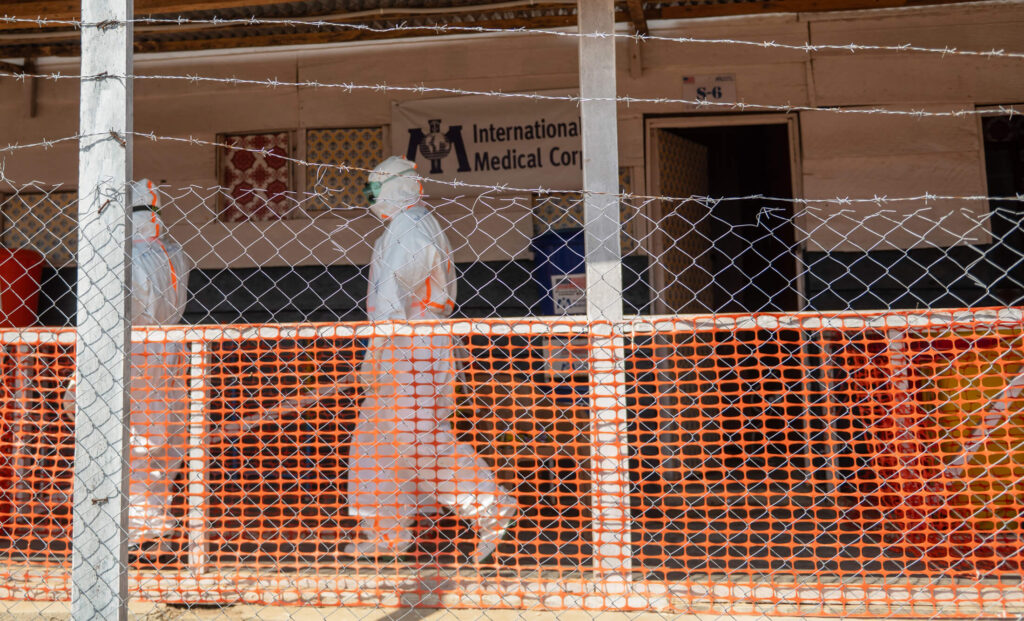
Dr. Jean Marie Kashosi has been on the frontlines of multiple Ebola outbreaks in the DRC since 2019. Despite the stress of working with such a deadly disease, he says that being a repeat responder has been worth it to help people.

Read more
Items
Filters:
Story

Snapshots October 2026

Creating Safer Spaces for Healthcare in Nigeria In Monguno, Borno State, Nigeria, International Medical Corps’ Water, Sanitation and Hygiene (WASH) team is working to improve water and sanitation at healthcare facilities to ensure that patients and healthcare workers have cleaner, safer environments. Through infrastructure rehabilitation, repair work and improvements to water and sanitation facilities, our …

Continue Reading

Story

June Snapshots 2026

Partnering with the US Government to Stop the Spread of Ebola in Central Africa When an outbreak of infectious disease happens, communities are often unprepared. After an outbreak of Ebola was declared in the Democratic Republic of the Congo (DRC) in mid-May, many health facilities had to be adapted to screen and treat patients—and some …

Continue Reading

Story

The Fight Against Cholera in Nigeria

On May 1, the first case of acute watery diarrhoea (AWD)—a telltale symptom of cholera—was reported in the local government area (LGA) of Maiduguri Metropolitan Council, in Borno State in northeastern Nigeria. Since then, cholera has spread into 18 LGAs and has caused nearly 15,000 cases and 115 deaths. Cholera is a bacterial disease that’s …

Continue Reading

Story

What Is Cholera and How Do We Fight It? Here’s What You Need to Know

Though cholera is a severe and sometimes deadly disease that can spread rapidly and devastate communities, it is also preventable and treatable. Quick access to healthcare, safe drinking water, proper sanitation and good hygiene practices can dramatically reduce the risk of transmission—and save lives. Below, we answer some of the most common questions about cholera, …

Continue Reading

Story

Caring for Our Mental Health and Those Around Us

International Medical Corps is working with the government of Nigeria to expand access to specialised mental health and psychosocial support (MHPSS) in the Gwoza Local Government Area (LGA). Through targeted outreach, care is now reaching people where they are—helping people affected by years of insecurity, displacement and economic hardship. In this context, many people living …

Continue Reading

Story

A New Beginning for Damboa

In northern Nigeria, sisterhood is sacred. If one sister dies during childbirth or soon after giving birth, another often adopts her newborn niece or nephew. It’s a common cultural practice that maintains family bonds and preserves the memory and motherly love of the lost sister through the bond formed between aunt and child. I know …

Continue Reading

Story

Global Relief in Focus: 10 Images that Defined Humanitarian Aid in 2025

The Los Angeles wildfires in January 2025 marked the beginning of a year full of humanitarian challenges. Natural disasters, outbreaks of infectious disease and ongoing conflicts around the world led to displaced families, hungry children and the overwhelming need for emergency health services. But as always, our teams remained steadfast in our mission of providing …

Continue Reading

Story

“Pressure, Packing and Speed”: Inside Our Emergency Training in Nigeria

In late October, a group of International Medical Corps trainers convened in the sweltering heat of Maiduguri, Nigeria, to train frontline government healthcare workers from Borno and Katsina states—two states with enormous humanitarian needs stemming from armed conflict, widespread hunger and displacement. To maximise the improvement to local health outcomes, our Emergency Response Unit (ERU) …

Continue Reading

Story

Helicopters, Sisterhood and Hope: A Journey of Learning and Inspiration

Earlier this year, I had the incredible opportunity to travel to Nigeria on a temporary deployment. The purpose of the visit was to learn about the Economic and Social Empowerment (EA$E) approach, which is integrated with the Nigeria mission’s gender-based violence (GBV) program and women’s and girls’ safe spaces (WGSS). It took me three days …

Continue Reading

Page: